Are Scratch Tickets Random?

Surprisingly, scratch tickets are NOT random! This may seem like a bold statement, but that is why you have the best chance to gain an advantage over others and why the strategies described in this website give you a better chance of finding winners. In fact, scratch tickets are deterministic rather than random. Let’s take a look at a Texas Lottery game, $5 Money Money Money [2670]. There are six top winners, of $100,000, with odds of winning 1:1,200,000. There are about 7.2 million tickets in the game, if the game was truly random, it would be possible to only have 5 top winners or even less with bad luck, but the next time you printed the game you could have 7 or more top winners. Here’s a simple analogy, we’ve all flipped coins and know the odds of getting heads is 1:2 and we’ve all flipped heads four or five times in row, or not seen heads in several flips, that’s how randomness works, and that is the basis for the large Powerball jackpots, long streaks of bad luck. So how do scratch tickets fit into this analogy? Well the odds would still be the same, 1:2, but every two times you flip the coin you are guaranteed one heads! This is very important to understand. So now let’s go back to our example from Texas. Let’s say half the tickets have been sold but none of the six top winners have been sold, not likely, but possible. If that happens, your odds for winning just increased to 1:600,000! So how would you know that half the tickets were sold without any top winners? Texas lottery tells you on their website.
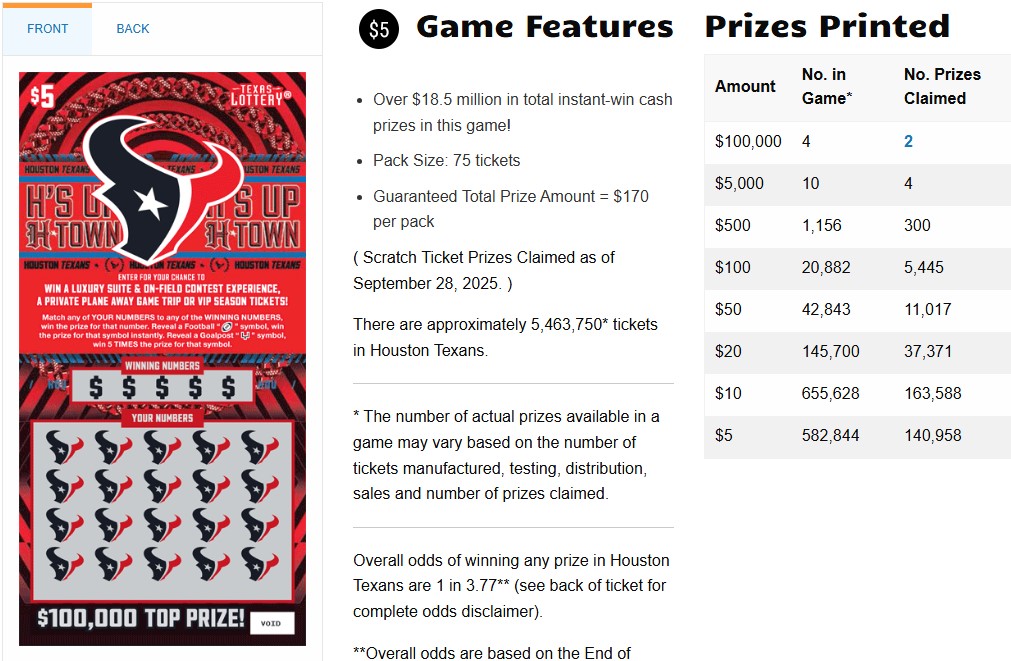
Here’s another example, in this case 24% of the tickets have been sold, but 50% of the top winners have been sold and even 40% of the $5,000 winners have been sold, making this game less than ideal to play. Wouldn’t you rather play a ticket with 24% sold and none of the top winners sold? This is the basis for one of our advanced strategies.
OK, hopefully everyone understands that, because there’s another reason why scratch tickets aren’t random! Look closely at the picture above, it states that every book of 75 tickets is guaranteed to pay out at least $170! If you also look at the odds of winning each prize, you would see that every book of 75 tickets would contain 8 $5 winners, 9 $10 winners, and 2 $20 winners, which is 19 winners for $170. Sure some books could have two extra $5 winners and one less $10 winner, but you get the idea, this isn’t random and in fact is the basis for one of our basic strategies. To summarize, the $5, $10, $20 winners are randomly distributed into each book of tickets, and then the remaining larger winners are randomly distributed among all of the books of tickets. This means if you get a winner larger than $20, an outlier, then you should stop playing that book of tickets, that’s another of our basic strategies.
What is unclear is do all states guarantee minimum winners in every book? I’ve looked at a few states and so far only Texas states it in writing, but I expect all states do something along those lines, even if they don’t state it. The reason why I think this is that you would have a lot of really bad books, and of course good ones, but if a retailer gets a bunch of bad books and another gets good ones, they may start getting a reputation. I’ve only purchased one book of tickets so far in Vermont, and it paid out exactly what it was supposed to according to the odds. I’ve seen plenty of books scratched on YouTube, but haven’t had a chance to analyze them. If you have any experiences from other states, please post a comment below.
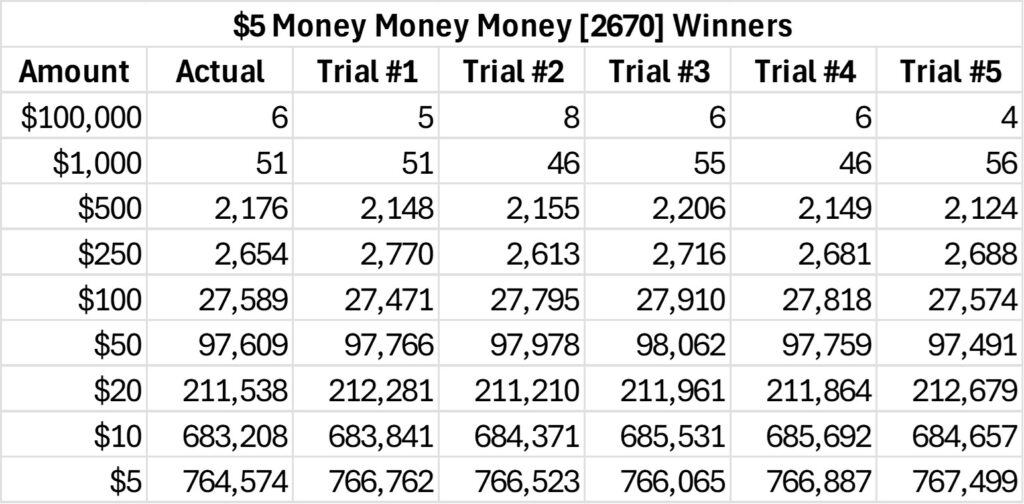
To wrap up this topic, I compared the Texas lottery example I mentioned at the top to completely random games generated using the same odds for that game. It’s fairly easy to do this with a computer and then run it multiple times for a small Monte Carlo analysis. You can see the results below. If you look at the big prize, there are 6 in the actual game being sold now, but when you use a purely random model, you can see what happens, some times you get more winners and some times less, that’s how true randomness works and shows why scratch tickets aren’t random! Now let’s take a closer look at each book generated within one of the trials. Remember, there are $200 in winners minimum, which equates to 19 winners [typically, this is not guaranteed] out of a book of 75 tickets. When using truly random numbers, 1500 books had $100 or less in winners, the worst with only $30, 1300 books had 10 or fewer winners, with 5 being the fewest, and 900 books had 28 or more winners, with 38 being the most, more than half the tickets in the book, tell me you’ve got one of those!